
“Cockroaches don’t ever fear, they never die either.”
Now, I don’t entirely agree with the “don’t ever fear” part — I’ve spent a few recent evenings playing peekaboo with some uninvited ones in my own home. And they are never in the mood, and go straight into hiding.
But that one line still stopped me mid-scroll. Because hiding inside it is an idea I keep coming back to in my own work: the Cockroach Portfolio. One of the most useful — and most misunderstood — ideas in long-term wealth building.
So let me share a very well-known idea in portfolio management: the Cockroach Portfolio.
Why the cockroach?
Markets love glamorous mascots. The bull. The bear. The occasional unicorn. Nobody picks the cockroach.
But the thing has survived 300 million years. It outlived the dinosaurs. It can reportedly survive a nuclear blast. It isn’t the fastest or the prettiest creature in the room — just the one still standing when the lights come back on.
And that’s exactly what I want from a long-term portfolio.
The “Cockroach Portfolio” is a nickname for an all-weather portfolio: built not to predict the market, but to survive whatever it does. The original, credited to Harry Browne, is simple — split your money roughly equally across four buckets:
- Stocks — for growth
- Bonds — for deflation and steady income
- Cash — for safety and dry powder
- Commodities / Gold — for inflation and crises
At any moment, something in the mix is having a good day. Stocks crash, gold shines. Inflation bites, commodities help. Everything wobbles, cash holds the fort. You never win the year — but you never get wiped out. You just keep showing up. Very cockroach.
Modern versions push further, into “fractal diversification” — spreading risk not just across assets but within them: geographic (India, US, emerging markets), style (large-, mid-, small-caps), type (equity, bonds, REITs, gold), and across the economic cycle. Same goal: take a punch from any direction and keep walking.
The boring chart that proves the point
Here’s the part that keeps me humble.
The “best” asset class in India changes almost every year — and I’ve never met anyone who can reliably guess it in advance. Over any ten-year stretch, gold, bonds, overseas equity and domestic equity have all taken turns wearing the crown.
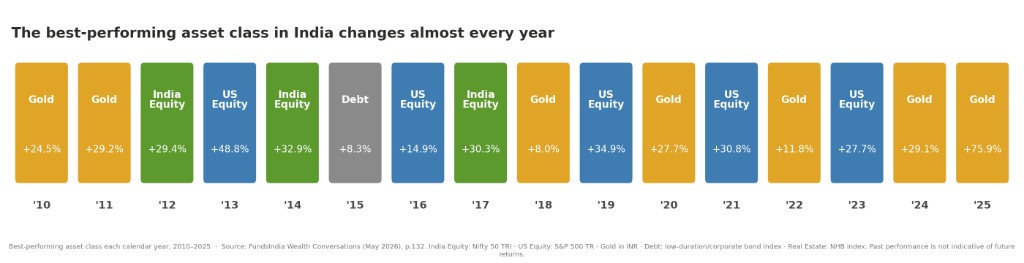
So here’s what I’ve made my peace with: whichever asset you fall in love with, there will be long stretches where it disappoints you — and something you ignored quietly does the heavy lifting.
Where Inertia parts ways with the cockroach
The textbook cockroach portfolio refuses to take any view. Equal weights, forever, rebalanced like a machine. It treats a stock at a bargain and a stock in a bubble as the same thing. Fine for someone with no adviser and no patience.
So here’s where I put down the metaphor and tell you how we actually do this at Inertia — because the textbook cockroach portfolio missed the one strength we have: YOU and I. The PARTNERSHIP.
We believe equity is the true compounder (especially in a high-growth economy like India) — the engine of long-term wealth, not one of four equal passengers. Bonds, gold and cash are the suspension and the brakes. Important. Stabilising. Not the engine.
So how do we avoid the cockroach’s blind spot and the far more common mistake — pouring everything into equity at the worst possible moment?
Our answer rests on something money can’t buy and a robo-adviser can’t replicate: the privilege of trust, and a long-term relationship with our clients.
When a client commits for the long haul, they hand us the most powerful tool in investing — TIME. And time buys flexibility most investors never get:
When equity is reasonably valued, we accept concentration. We lean into the compounder — that’s where wealth is genuinely made.
When equity gets expensive, we don’t panic-sell and we don’t force money in at silly prices. We aggressively divert fresh capital into other sleeves — international equity, REITs, bonds, gold — and resume equity when valuations come back to earth.
We don’t acquire a multi-asset portfolio in one afternoon by buying a bit of everything at today’s prices. We love building one — sleeve by sleeve, over time, accumulating each asset only at a sensible entry point.
This matters more than it sounds. Invest a lump sum at the market peak and you’d have waited over two years just to break even, six to see real profit. The price you pay decides the return you get. The cockroach survives by never having a view. We compound by using the gift of time to have a patient one.
With all due respect to the cockroach — we are not one.
The cockroach survives. That’s its genius, and it’s not nothing.
But survival alone doesn’t build wealth. Compounding does — and the true compounder is equity.
So we borrow the cockroach’s resilience and refuse its ceiling. We don’t invest merely to survive volatility; we invest to compound through it — to build an ever-expanding safety net for the people our clients love, and the freedom to chase whatever they dream of next. That freedom is what inspires us. It’s what lets our investors stay calm when markets are loud, and keep dreaming about what they’re up to next.
The real edge, then, isn’t choosing between concentration and diversification. It’s the patience to switch between them on valuation:
Equity is the engine. Time and trust are the edge.
We diversify aggressively when equity is dear, concentrate confidently when it’s cheap, and use the long runway our clients give us to build a genuinely diversified portfolio at prices that make sense — not the prices the market happens to quote on the day you walked in.
And here’s the subtle part. We don’t buy other assets because we predict they’ll do well — we buy them simply to avoid buying something expensive. That shift in intent is what makes this doable. Predicting which asset will do best next is impossible. But knowing that a particular asset has run well beyond its fundamental value — that’s very doable. And that’s what we do.
The cockroach refuses to die. I’d rather our clients’ portfolios refuse to die and quietly thrive — and fund a life worth living. That second part takes a little more patience. And the kind of relationship that makes patience possible.
That’s how we build the portfolio. But what happens once it’s built — when it has to start paying you back? That’s the reverse journey: it starts cockroach, stays cockroach, and always sells what’s expensive. More on that in the next note.